Tuesday, April 16, 2013

2014 Camaro Z/28: The Bad is Back


Photo credit: Autoblog.com
Like many of my fellow enthusiasts, my automotive preferences lie with low-weight, high-power performance cars. This sector is primarily filled with stripped-out Porsches, Ferraris, BMWs and Audis, which are more often-than-not unobtainable to the common working man. This disturbing trend of “less weight means more money” was not always the case, though. In the late 1960’s, America found itself embroiled within an internal motorsport battle-royale. The SCCA (Sports Car Club of America) developed a racing series called the “Trans-Am Series” that featured production-based race cars, which participated in either the Under 2.0 Liter or the Over 2.0 Liter class. European manufacturers, such as Alfa Romeo and Porsche, competed alongside the best America had to offer, with race-offerings from nearly every corporate division.

Grid from the Golden Era of Trans-Am racing

Ford developed the Mustang Boss 302, while sister company Mercury offered the Cougar XR7. Chevrolet masterminded the almighty Z/28, and the S-Code designation for the Plymouth Barracuda was made specifically for the Trans-Am series. These cars were piloted by some of the biggest racing names ever to grace the tarmac, drivers such as Parnelli Jones, Dan Gurney, and Swede Savage. However, my absolute favorite of the legendary Trans-Am drivers has to be Mark Donohue and his Penske/Sunoco Camaro Z/28.  


No other classic racecar has left quite the same impression on me than the royal-blue-on-yellow Sunoco Camaro. With Donohue at the helm, the Sunoco Camaro snagged the first place in the ’68 and ’69 Trans-Am series, thus cementing the Z/28 into racing history. The Trans-Am battle was not just relegated to the track, however. Trans-Am fever spilled over onto the streets of America as homologation specials roared from stoplight to stoplight. While the Boss Mustang badge was discontinued in the mid ‘70s, the Z/28 proved to have staying power. The Z/28 badge was carried on from ’68 through ’74, reintroduced in ’77, and continued all the way up until the final Camaro year in 2002. With the demise of the Camaro, it meant the demise of the Z/28, and the end to a road-racing legacy. Sure, some of the Z/28 models in the ‘70s and ‘80s were less-than-inspiring, but the badge was always so damn mean. The death of both the Camaro and the Z/28 legacy was a huge blow for the masses of Camaro fans worldwide.

However, I’m happy to report the Z/28 has returned to the world of the living. The badge is back. The ‘mean’ is back.

The bad is back.

Photo credit: Autoblog.com 

At the 2013 NYC Auto show, Chevrolet revealed one of the most hardcore vehicles it has ever produced. The 2014 Camaro Z/28 sports a 300 lb. weight reduction, thanks in part to thinner glass, a diet-heavy alacantara-swathed interior, and new lightweight wheels. Cog-swappers, rejoice; The Z/28 is a manual-only muscle car. The Camaro receives a heavily reworked chassis, carbon-ceramic brakes, and a sexy front-splitter/undertray system. Lets go back to the previous statement; Carbon-ceramic brakes….on a Camaro! What a world we live in…..

It also is fitted with a new engine, and oh my goodness, what an engine it is.

I have not been looking forward to the eventual and inevitable death of the C6 Z06 Corvette. The discontinuation of the Z06 would mean the discontinuation of the LS7, which in my eyes, is one of the greatest American V8s produced in the last decade. GM must have noticed my tearful depression, and amazingly, the 7.0L smallblock has been given a lifeline with the Z/28. Oh yes, America has a 427 Camaro once again. Do I smell a factory Yenko package on the horizon? I sure hope so. And for those not convinced, here is what you have to look forward to:


Lets recap. A lightened, manual-only 500 HP 427 Camaro with active-aero, Recaro seats, and carbon-ceramic brakes. Oh my. If that does not get your heart racing, please visit your doctor, because that’s the greatest list of options ever to grace an American muscle car, ever. If its not already apparent, I’m just a bit excited.

 These statistics are all well and good, but how does the Z/28 stack up to against its competition?

Well, the inadequate resurrection of the Camaro ZL1 nameplate has the Shelby GT500 covered, and the parts-bin special 1LE Camaro faces the Mustang GT Track Pack. The obvious choice would be to compare the Z/28 to the new Boss 302, but Ford dashed the hopes of fans everywhere with the news of no Boss for the 2014 model year. That being said, lets do a little math and logic to see if the Z/28 can come out on top.

In a comparison between the 2012 Camaro ZL1 and the quite ridiculous 2013 Shelby GT500, the GT500 is bested around a track setting by roughly one half-second. Then, according to Chevrolet themselves, the ZL1 is whipped by the Z/28 on an unnamed track by over a mind-boggling three seconds per-lap. Enter Boss, stage left; the ZL1 trounces a Boss 302 Laguna Seca by about two seconds in this professional MotorTrend comparison. Don’t even bother with the Dodge Challenger SRT8 392, as I highly doubt the too-heavy cruiser could even best a Mustang GT around a track. Also withheld are the Cadillac CTS-V and Corvette due to a higher price point and the fact that the Corvette is not a muscle car.  So, without any real world tests, drag strip rumbles, or diagnostics, we can unofficially say that the Z/28 is the fastest muscle car around a track setting. You can keep your 660 HP quarter-mile missiles, Shelby. I want this Camaro GT3 RS.

Photo credit: Autoblog.com
The return of the Z/28, Boss, Stingray, and ZL1 within a two year span indicates much for the future of American muscle. Maybe we will see a return of the Chevelle, 442, CobraJet, and Mach 1. Maybe a Boss 429?

How about we bring back Pontiac, first. 

Tuesday, February 5, 2013

Video: The sweet, sweet violence of anti-lag


I cannot think of any other sound that exemplifies the violent nature of internal combustion engines so well. Backfires, caused by the ignition of unburnt fuel in either the intake or exhaust manifolds, is ever-present in high performance, low durability turbo motors.

With anti-lag technology, fuel is ignited in the exhaust manifold in order to spool the turbo in absence of engine load, thus resulting in instant, usable boost at nearly any RPM. It is widely used in modern rally cars, as we see demonstrated by the Lancia.

Take a look at this Delta as it crackles and pops through the streets, heralding the presence of a turbocharged monster.

2014 C7 Corvette: Evolutionary, not revolutionary

Photo credit: Autoblog.com
Let me begin this post by making my opinion on the C7 readily apparent, so that there is no chance for confusion.
 I think the C7 Corvette is a thing of beauty. Even as a hardcore Porschephile, I wouldn’t think twice about plunking down my hard-earned hypothetical money for a bright red C7 in lieu of a 991 Carrera. Simply put, the C7’s performance-per-dollar ratio eclipses absolutely every contender on the market, even without any official pricing information. GM has out done itself; rising from the ashes, it produced a through-and-through performance world-beater.

 There is one thing that seriously bothers me about the C7, however. The fanfare that accompanies the unveiling of perennial icons in the automotive industry, like a new 911, Mustang, or SL Class, is always laden with automotive superlatives and hype that finds the general fan base screaming praises and irrelevant buzzwords at whoever is around to listen. The release of the C7 was no different.
The C7 buzzword du jour is ‘revolutionary’. To truly speak of a car as ‘revolutionary’, it must be a jarring departure from the established norm. The C7, at face value, is not revolutionary. I am being slightly unfair at this point, as much of the technology is indeed groundbreaking, if only at the Corvette’s price point. Perhaps a closer look into the history of the Corvette will provide better examples.
The primary point of praise (or lack thereof) is the C7’s aesthetic design. It incorporates functional ducts, aero effects, and a heavily revised rear-end, all while retaining the classic Corvette silhouette.

This is where the issue resides.

The last “revolutionary” Corvette, in terms of design, was the C4. Take a look at the Corvette generations. The eternal Corvette shape was “found” in the C4 (hint: the gold one). The C2 was a massive departure from the C1, and the C3 slimmed the design down, appearing sleek and svelte in its profile. The C4 eliminated the curves, and added a pinch of ‘80s boxy-ness that has become a mainstay of Corvette design up to the current C7. The C4 is undeniably the genesis of the modern Corvette, the influence of the design riding through the decades, all the way up into the 2014. The C7 is not a revolution, but an evolution. Is this a bad thing? Absolutely not. In fact, this is the trademark of heritage. Is there another car, besides the Corvette, that is successful in design, racing, sales, and pedigree, that has stood the test of time despite having the same basic layout and visual profile? I can think of one. 
 Has the Porsche 911 suffered for its stubborn design? No. The timeless design became the defining feature of the 911, allowing Porsche to cement itself onto the automotive landscape. With this in mind, what is the issue with approaching the Corvette with the same outlook?
From a technological standpoint, the formula of progression has not changed much at all. Each new Corvette model is heralded for its bargain performance, a true supercar killer. The C7 is not exempt from this, many people calling it the performance bargain of the decade. I am inclined to agree, but the C6 and its variants were labeled as such in their time as well. I cannot remember any other supercar, post-2000, that caused as much of an uproar than the C6 ZR1. Backed into a corner in 2009, GM flexed their muscles and created a sports car that is nothing short of a masterpiece. A world beater, indeed.

So what makes this new Corvette ‘revolutionary’?


Nothing. It brings nothing new that Ferrari and Porsche hasn’t already achieved (Think 7-speed manual transmission) to the game. Sure, if you squint real hard, you can say the C7 is “revolutionary” within the constraints of the Corvette universe. The interior is one hell of a leap forward from previous iterations, and the all-new LT1 engine is (evidently) superior to the LS series of V8s that it replaces. Power is up by about 20 horsepower, and the 0-60 time drops by about .2 seconds. Impressive? Nothing I would call world changing. Sure, a car is more than a list of stats, but if you listen to the journalists who covered the reveal, one would think it’s the only thing that matters.

I look to sports car evolution with an eye to tradition and a certain respect for the past. The C7 is already one of the all time great sports cars, but its fans have been too quick to run from its heritage, eschewing past ancestry for the “All new, better, different” Corvette.
That makes me a bit sad. 

Monday, February 4, 2013

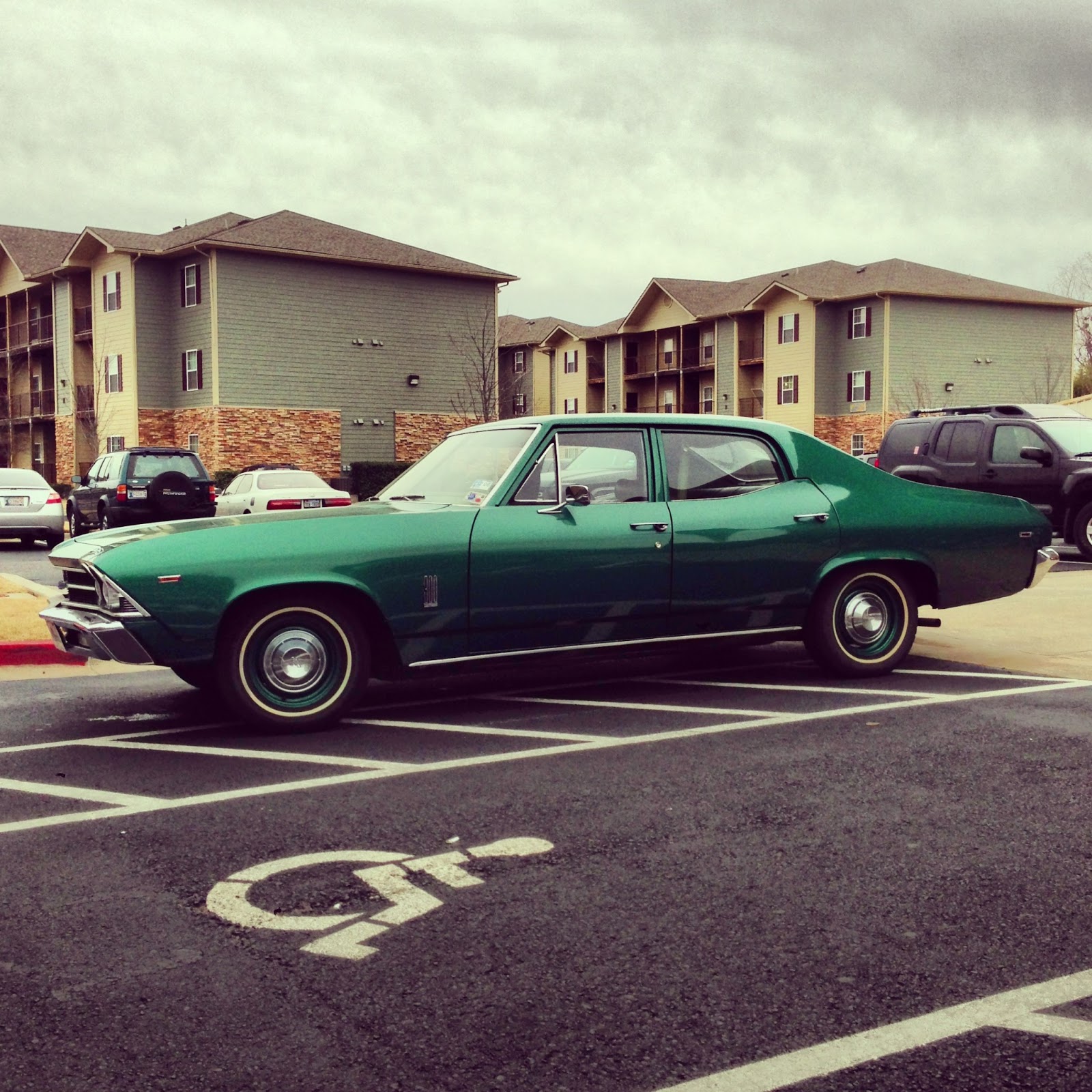
A Man and his Project: 1969 Chevelle 300 Deluxe

The first thing that caught my attention was not the sleek, muscular coke-bottle lines of the body. It was the not the luscious emerald/mint hue of the paint. It was not the gleaming chrome trimmings that adorned the classically beautiful grille. No, what immediately captured my attention was the extraordinarily large puddle of fluids residing under the engine bay, accompanied by a thin trail of oil curving down the length of my apartment parking lot.

Oh, dear.

More on that, later. For the extent of this week, my roommate decided to upstage my status as the resident classic car eccentric in my apartment complex when he brought up his 1969 Chevrolet Chevelle 300 Deluxe Sedan. Since we were introduced, I was aware of his Chevelle ownership. Until he provided me with photographic evidence, however, I was unaware that a Chevelle was available in a sedan configuration. My mind fretted over the seemingly sacrilegious idea that a “Heavy Chevy” could be anything but a coupe. When he informed me of his intentions of bringing it up from Edmund, I was nervous. How would I react? Would I accept this faux-muscle? Can I see past the addition of two doors on the body of muscle-car royalty?

Heck yes. The car is gorgeous.

First off, it is worlds smaller than I imagined. Chevelle Coupes are portly fellows, to be sure. With rotund haunches, abyssal wheel-wells, and a freightliner sized width, these bruisers dwarf anything short of a truck.  The Deluxe sedan, however, fits into its bulk perfectly. The doors are gracefully sculpted into the smoothly aggressive roofline, and from a side view, the profile is decidedly progressive. It seems as though the advent of a “four-door coupe” was birthed long before the Mercedes CLS claimed originality.


Returning to the disturbing fluid leak, my roommate assured me that he keeps the levels topped off. Upon further inspection, I believe it to be a mostly harmless leaky gasket, so I put aside my initial anxieties as I popped open the industrial-sized door and slid behind the pencil-thin steering wheel. I was immediately assaulted by a rush of brilliant period switches and gauges that heralded a simpler and outrageously chic era when style trumped substance. Now, the majority of my “classic” automotive experiences have been had in mid-70’s economy boxes and early ‘80s Euro luxury coupes that rivaled public libraries in their austerity. To me, all of the beautifully scripted paraphernalia adorning the dash was a breath of fresh air. The doors closed with a surprisingly Porsche-like thunk, sealing me in a spacious vault of vinyl bench seats and metal touchpoints.

A tired Turbo-Thrift 250 inline-6 resided under the capacious hood, mated to a delightfully interesting column-mounted three speed. The interior wore its patina with pride, having most of the trim still sealed in place with as much care GM could muster from the factory. Tanner was understandably hesitant to permit anyone but himself to pilot the Chevelle, so I gleefully accepted the position of Co-pilot. After some heavy starter whine, the car spun to life with a few prodigious stabs of the throttle, emitting a low, guttural burble from the dripping sixer. After maneuvering the boat out of the complex, we encountered the first corner of the test drive.

My initial impressions of cornering capabilities were tinged with slight concern. Body roll, followed by a not-so-subtle jostling from the trampoline-like seats exemplified '60s American land-yacht handling. The chassis heaved to and fro, straining against itself as it pushed its way out of the sweeping left corner. Honestly, even my 1974 Baja Bug feels more planted and stable than the Chevelle. This, however, is not necessarily a bad thing, and can be easily rectified with the addition of wider tires and replacement struts. I found his braking to be adequate, never causing me any worry. He claims that it pulls violently to the left under braking, but I thankfully was not privy to this as we trundled down the road.

The old Turbo-Thrift 250 offered up surprisingly adequate acceleration. It pulled its hefty bulk along at a very reasonable pace, to my dismay. There is no doubt in my mind that the MudBug would be embarrassed come a stoplight race.


Riding along with Tanner, and hearing him cheerfully inform me of the various issues and bugs his “Rosie” had, perfectly illustrated the kinship that unites “car guys”. My '74 Baja Bug, lovingly nicknamed MudBug, is a complete heap. It is unreliable, spits oil, reeks of gasoline, rusts when it gets muggy, has no creature comforts, and is consistently noisy, busted, and abused.  I am aware of all of these issues, and honestly, I wouldn’t have it any other way. Girls think it is adorable, right up to the point when they sit inside. My fraternity brothers refer to it as scrap metal. My own mother refuses to touch it, for fear of tetanus. All this being said, their opinions on the subject of my MudBug really don’t matter at all. In fact, in this age, it is expected that the MudBug is rejected as a relic of the ugly past. If you don’t “get it”, you never will. There is no forcing yourself to be a “car guy”. It comes naturally. Sitting in Tanner’s leaking Chevelle, the relationship between the gearhead and his project car became readily apparent. No matter the money and struggle you put into “the damn thing”, as long as you can find inane and desperate reasons for continued ownership, it is a beautiful thing.

To this, Tanner, I give your “Rosie”, my complete adoration. Keep driving, and top off that oil!


Monday, November 12, 2012

Spotted around Norman: Celica GT


The Silent A20

 The Red-Capped Steelies
The daily afternoon trudge back to my apartments began earlier this semester as a peaceful journey of introspection, but quickly turned blasé in the face of ill-suited footwear and a hefty bookbag. However, I regularly undertake the daily pilgrimage for a glimpse of the beige, tarped mass in the front lawn of an unassuming residence en route. The first time I noticed the mystery car, I was hesitant to investigate further than a simple visual assessment. The car is located on a somewhat busy thoroughfare, and I am reasonably sure local residents would react poorly to a hooligan covertly sticking his head under the cover of a parked car. As I could make out, the only visible features are chocolate-brown running boards/skirts with white stripes and robust red-capped steelies. I ventured closer to discover a raked roof, sleek rear end, and a short wheelbase. In other words; the general proportions of a small sports coupe. Further investigation reveals the red center caps on the steelies are emblazoned with a small, silver “T”. Aha! A crest. After much deliberation with colleagues on auto forums and boards, we determined this to be a very attractive first-gen Toyota Celica. What a find!  

A cleanly stanced A20
 As I discussed in an earlier post about the Mk.1 Capri, both European and Japanese automakers began to look to American Muscle for design influences in the late ‘60s and early ‘70s. The muscular lines of pony cars proved to be extremely popular with the younger crowd, and sales figures reflected this. The Europeans released cars like the Capri and the Aston Martin V8 Vantage, while the Japanese found their “muscle” in the Datsun 240Z, Mazda RX-3, and the Toyota Celica GT. These sports cars had sleek aggressive styling of their American Muscle counterparts, but retained a relatively cheap buying price. This design/sales formula was a runaway success, as the Celica model was continued on for over 30 years. Due to somewhat simplistic and lightweight mechanical construction, this generation of Celica in particular is quite popular with the tuning and stance crowd. If I had my way, a cliché single-turbo 2JZ would be found under the hood of every modified A20 Celica out there.

 I am unsure if this particular A20 is in running condition. As of this posting, the car has apparently remained unmoving, at least to my observations. I believe, however, that due to the robust nature of Toyotas from this era, not much more than gentle mechanical reconditioning is needed to see this Japanese charmer back onto the road.

UPDATE: I was fortunate enough to run into the owner. More info on the car to come!


Coming soon: The Norman Opel GT