Monday, February 4, 2013

A Man and his Project: 1969 Chevelle 300 Deluxe

The first thing that caught my attention was not the sleek, muscular coke-bottle lines of the body. It was the not the luscious emerald/mint hue of the paint. It was not the gleaming chrome trimmings that adorned the classically beautiful grille. No, what immediately captured my attention was the extraordinarily large puddle of fluids residing under the engine bay, accompanied by a thin trail of oil curving down the length of my apartment parking lot.

Oh, dear.

More on that, later. For the extent of this week, my roommate decided to upstage my status as the resident classic car eccentric in my apartment complex when he brought up his 1969 Chevrolet Chevelle 300 Deluxe Sedan. Since we were introduced, I was aware of his Chevelle ownership. Until he provided me with photographic evidence, however, I was unaware that a Chevelle was available in a sedan configuration. My mind fretted over the seemingly sacrilegious idea that a “Heavy Chevy” could be anything but a coupe. When he informed me of his intentions of bringing it up from Edmund, I was nervous. How would I react? Would I accept this faux-muscle? Can I see past the addition of two doors on the body of muscle-car royalty?

Heck yes. The car is gorgeous.

First off, it is worlds smaller than I imagined. Chevelle Coupes are portly fellows, to be sure. With rotund haunches, abyssal wheel-wells, and a freightliner sized width, these bruisers dwarf anything short of a truck.  The Deluxe sedan, however, fits into its bulk perfectly. The doors are gracefully sculpted into the smoothly aggressive roofline, and from a side view, the profile is decidedly progressive. It seems as though the advent of a “four-door coupe” was birthed long before the Mercedes CLS claimed originality.


Returning to the disturbing fluid leak, my roommate assured me that he keeps the levels topped off. Upon further inspection, I believe it to be a mostly harmless leaky gasket, so I put aside my initial anxieties as I popped open the industrial-sized door and slid behind the pencil-thin steering wheel. I was immediately assaulted by a rush of brilliant period switches and gauges that heralded a simpler and outrageously chic era when style trumped substance. Now, the majority of my “classic” automotive experiences have been had in mid-70’s economy boxes and early ‘80s Euro luxury coupes that rivaled public libraries in their austerity. To me, all of the beautifully scripted paraphernalia adorning the dash was a breath of fresh air. The doors closed with a surprisingly Porsche-like thunk, sealing me in a spacious vault of vinyl bench seats and metal touchpoints.
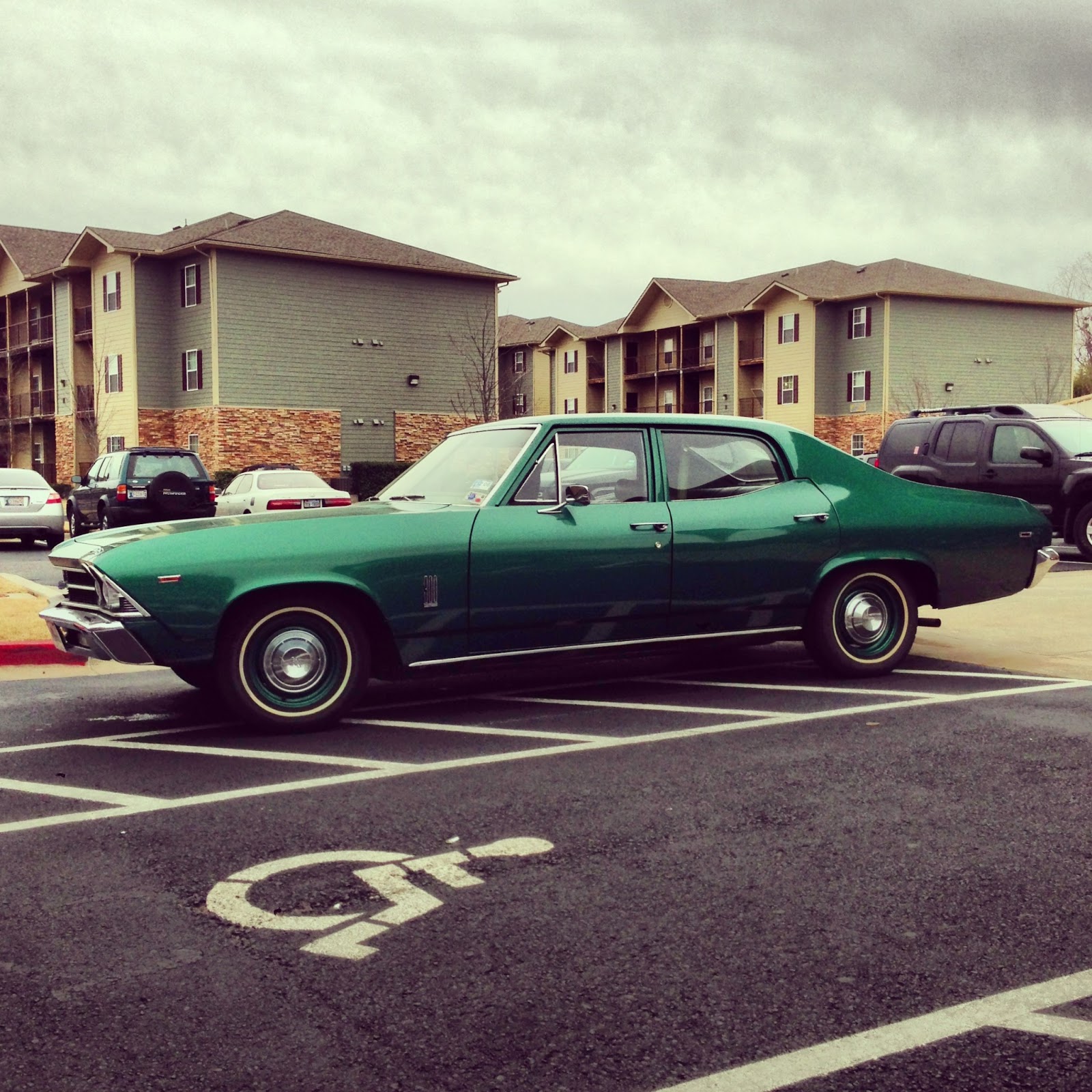
A tired Turbo-Thrift 250 inline-6 resided under the capacious hood, mated to a delightfully interesting column-mounted three speed. The interior wore its patina with pride, having most of the trim still sealed in place with as much care GM could muster from the factory. Tanner was understandably hesitant to permit anyone but himself to pilot the Chevelle, so I gleefully accepted the position of Co-pilot. After some heavy starter whine, the car spun to life with a few prodigious stabs of the throttle, emitting a low, guttural burble from the dripping sixer. After maneuvering the boat out of the complex, we encountered the first corner of the test drive.

My initial impressions of cornering capabilities were tinged with slight concern. Body roll, followed by a not-so-subtle jostling from the trampoline-like seats exemplified '60s American land-yacht handling. The chassis heaved to and fro, straining against itself as it pushed its way out of the sweeping left corner. Honestly, even my 1974 Baja Bug feels more planted and stable than the Chevelle. This, however, is not necessarily a bad thing, and can be easily rectified with the addition of wider tires and replacement struts. I found his braking to be adequate, never causing me any worry. He claims that it pulls violently to the left under braking, but I thankfully was not privy to this as we trundled down the road.

The old Turbo-Thrift 250 offered up surprisingly adequate acceleration. It pulled its hefty bulk along at a very reasonable pace, to my dismay. There is no doubt in my mind that the MudBug would be embarrassed come a stoplight race.


Riding along with Tanner, and hearing him cheerfully inform me of the various issues and bugs his “Rosie” had, perfectly illustrated the kinship that unites “car guys”. My '74 Baja Bug, lovingly nicknamed MudBug, is a complete heap. It is unreliable, spits oil, reeks of gasoline, rusts when it gets muggy, has no creature comforts, and is consistently noisy, busted, and abused.  I am aware of all of these issues, and honestly, I wouldn’t have it any other way. Girls think it is adorable, right up to the point when they sit inside. My fraternity brothers refer to it as scrap metal. My own mother refuses to touch it, for fear of tetanus. All this being said, their opinions on the subject of my MudBug really don’t matter at all. In fact, in this age, it is expected that the MudBug is rejected as a relic of the ugly past. If you don’t “get it”, you never will. There is no forcing yourself to be a “car guy”. It comes naturally. Sitting in Tanner’s leaking Chevelle, the relationship between the gearhead and his project car became readily apparent. No matter the money and struggle you put into “the damn thing”, as long as you can find inane and desperate reasons for continued ownership, it is a beautiful thing.

To this, Tanner, I give your “Rosie”, my complete adoration. Keep driving, and top off that oil!


Monday, November 12, 2012

Spotted around Norman: Celica GT


The Silent A20

 The Red-Capped Steelies
The daily afternoon trudge back to my apartments began earlier this semester as a peaceful journey of introspection, but quickly turned blasé in the face of ill-suited footwear and a hefty bookbag. However, I regularly undertake the daily pilgrimage for a glimpse of the beige, tarped mass in the front lawn of an unassuming residence en route. The first time I noticed the mystery car, I was hesitant to investigate further than a simple visual assessment. The car is located on a somewhat busy thoroughfare, and I am reasonably sure local residents would react poorly to a hooligan covertly sticking his head under the cover of a parked car. As I could make out, the only visible features are chocolate-brown running boards/skirts with white stripes and robust red-capped steelies. I ventured closer to discover a raked roof, sleek rear end, and a short wheelbase. In other words; the general proportions of a small sports coupe. Further investigation reveals the red center caps on the steelies are emblazoned with a small, silver “T”. Aha! A crest. After much deliberation with colleagues on auto forums and boards, we determined this to be a very attractive first-gen Toyota Celica. What a find!  

A cleanly stanced A20
 As I discussed in an earlier post about the Mk.1 Capri, both European and Japanese automakers began to look to American Muscle for design influences in the late ‘60s and early ‘70s. The muscular lines of pony cars proved to be extremely popular with the younger crowd, and sales figures reflected this. The Europeans released cars like the Capri and the Aston Martin V8 Vantage, while the Japanese found their “muscle” in the Datsun 240Z, Mazda RX-3, and the Toyota Celica GT. These sports cars had sleek aggressive styling of their American Muscle counterparts, but retained a relatively cheap buying price. This design/sales formula was a runaway success, as the Celica model was continued on for over 30 years. Due to somewhat simplistic and lightweight mechanical construction, this generation of Celica in particular is quite popular with the tuning and stance crowd. If I had my way, a cliché single-turbo 2JZ would be found under the hood of every modified A20 Celica out there.

 I am unsure if this particular A20 is in running condition. As of this posting, the car has apparently remained unmoving, at least to my observations. I believe, however, that due to the robust nature of Toyotas from this era, not much more than gentle mechanical reconditioning is needed to see this Japanese charmer back onto the road.

UPDATE: I was fortunate enough to run into the owner. More info on the car to come!


Coming soon: The Norman Opel GT

Monday, October 1, 2012

Driven: 2012 Porsche 997.2 Turbo Cabriolet


Intended Acceleration


“Don’t hurt yourself, please.” The words hung heavy in my mind as I concluded my phone conversation with my father, who at the time was abroad in Singapore. You see, I recently had the unique and fortunate opportunity to drive a 2012 Porsche 997.2 911 Turbo Cabriolet. Flashbacks of young Wall Street Professionals inducing deadly boost-oversteer into various hedges ran through my mind as I recalled the infamous “yuppie killer” 930 of the ‘80s. It had been established, at least by myself, that 911 Turbos are ballistic, overboosted, deadly autobahn crushers built to weed out the unworthy.  I recalled past car shows, where I met owners complaining of obnoxiously dangerous turbo lag with recalcitrant gearboxes that were terrible to operate at any speed under 80 MPH. Add in the awesomely imposing $163,000 price tag, and I was rightly concerned. While this worry was certainly fueling my nerves, one emotion took precedence over all others as I drove to the owner’s house; excitement.

As my eyes flitted over a Grabber Blue 2010 Shelby GT500 silently occupying the other bay of the garage, my thoughts of smoky burnouts and side-stepped clutch drops were wrenched back to reality by a throaty snarl emitted from the GT Silver Metallic Turbo Cabriolet I was to care for the entire weekend. The plan was to have a quick instructional ride up the highway with the owner before he released me to the unsuspecting streets. As we pulled onto the access road, I readied for the customary entry ramp blast. Now, I have driven multiple sub-4 second performance cars before, including a torquey Tesla Roadster S, so an unwarranted “I-have-done-this-before” mental smugness emerged as the owner engaged Sport Mode Plus while entering the on-ramp. The throttle was mashed, and in that moment, my perception of “fast” changed instantaneously. An absurd cocktail of pressure, speed, sound, and force assaulted the entirety of my senses as the cars around us turned into nothing more than colorful blurs, the Turbo cutting a swathe through the encroaching traffic. After I had a few breathless highway jaunts behind the wheel, the instructional portion was over. The car was mine for the weekend, and as I piloted the missile back towards North Dallas, I began to quickly map all of the quality back-roads just waiting to be tamed by my right foot.


 As I gradually became accustomed to the Turbo’s overwhelming performance, I began to investigate the various options and driving modes that were readily available. In most vehicles, a “Sport” mode mildly increases throttle response, slightly changes the shift points, and perhaps stiffens the suspension. The Turbo, however, has a wide array of switches and buttons that effectively control numerous parameters of how the car handles itself. This particular Turbo was fortunately optioned with the desirable Sport Chrono package, along with the amazing PDK (Porsche Doppelkupplungsgetriebe).The PDK consists of a Dual-Clutch, 7-speed Semi-automatic transmission that swaps cogs faster than I could ever hope to with a stick, thus eliminating that pesky, ever-present driver error. Engaging Sport Mode does exactly what is advertised. Higher shift points, stiffer suspension, and increased fuel delivery meant the car was ready for highway blasts and spirited backroad thrashings, and in my opinion, the ideal setting for the car. The computer kept the engine peaky enough to entertain, but sedate enough so not to annoy, and the suspension had a reassuringly pliable nature without being overtly soft. The driving aids are reduced, but still ensure you will not look the fool when the road turns twisty. Sport mode: Pleasant, fun, usable.

The car, in any mode, feels reassuring with its complex rear-bias All-Wheel Drive system doing its damnedest to keep you out of the hedges. Steering is agreeable, and allows for accurate mid-corner corrections. Turn-in is admittedly a bit delayed by slight understeer, however this is expected with any AWD vehicle, and is completely manageable. Mid-corner adjustments do little to upset the chassis, and it is not until you give it half-throttle you realize you need this car pointed in the right direction before any safe acceleration can occur. The back end needs no encouragement when it comes to mid-corner throttle. Upon sensing oversteer, the car steps in and applies power to the wheels which need it. Called Porsche Traction Management (PTM), the system is effective at keeping the car relatively stable with aggressive steering inputs. Combined with the Porsche Torque Vectoring system (PTV), which controls individual power output to each wheel, the car allows for moderate theatrics without compromising safety.  Seeing that this very expensive vehicle is not mine, I wisely decided to mostly keep my acceleration horizontal.  This is unfortunate, for the car seems to encourage heroics, and maybe if I get another chance behind the wheel, I will investigate further. The brakes are monumentally powerful, prodigiously sloughing off speed with its cross-drilled and ventilated 350mm discs. I found that they are painfully effective, as I accidentally over-braked from 75 MPH and entered an almost-missed exit at 15 MPH, nearly causing neck pain with the ferocity of the stopping power.


The first time I engaged Sport Mode Plus, I was traveling at around 40 miles an hour on a commercial road. I assumed the transition from Sport to Sport Plus would be like the transition is from Comfort to Sport; subtle, the changes taking place behind the curtains with no immediate indications of a system upgrade. Sport Plus is a complete paradigm shift from the refined character I was accustomed to. The PDK immediately dropped two gears, the throttle and engine becoming taut as a flexed muscle. The Turbo became dissatisfied at any speed beneath 50 miles per hour, yearning to viciously throw itself at any straight you dare point it towards. Sport Plus is perfect for overtaking with its available Overboost function, which provides an additional 36 lbs-ft of torque. When I wanted to scare or impress my friends in the passenger seat, this was the ideal setting. For simple driving around town, I despised its harsh downshifts and noisy engine. With normal acceleration from a stop, the PDK would appear confused, keeping the engine in the middle-rev range until it realized you are trying to be civil, where it would promptly upshift, before downshifting again the second you go anywhere near the throttle. The PDK could seamlessly be switched into manual mode with a flick of the paddles, but that quickly becomes obnoxious in traffic.  After a few high speed pulls in Sport Plus, the absolute duality of this car became apparent. In Comfort, the Turbo is a mild-mannered GT that could comfortably be driven every day for errands and moderate trips, provided you do not bury the throttle into the firewall. With the push of a button, the Turbo transforms into a brutal, unforgiving missile which is more home on the track than on the streets.

I eventually endeavored to explore the plethora of features and options present in the cockpit of the Turbo. The interior was draped in gorgeous red leather, with some of the most comfortable seats I have ever had the pleasure of sitting in. The touchpoints were either aluminum or soft-touch plastics, which lent an expected air of quality and solidity with every interaction. The media system had available iPhone integration, with the touchscreen media center simple and easy to interact with.  Frankly, the climate control system in the Turbo was amazing. Top down in 100+ degree Texas sun, the cooled/heated seats kept me relatively fresh and the vents blew strong and maintained cabin temperature well, even in motion. Speaking of the convertible top, the controls for raising and lowering the black cloth cowl were as simple as could be. Its party piece, however, was the ability to raise the top at speeds of 30 MPH or under, a necessity with intermittent summer/spring showers. Primary trunk storage was adequate for what I required. There was enough space for a large grocery trip, I believe, but do not expect to have enough space for anything larger than a small overnight bag. Honestly, however, grocery stops and extended road trips are not what this car is best at, nor should it be. This car is at its best when cruising the boulevard, top down, garnering many an envious glance from men and women alike as you park it in front of a swanky restaurant. For me, that was the shops at Highland Park Village in Dallas. Highland Park Village is the well-known stomping ground of Lamborghinis, Bentleys, Ferraris, and any other high-market brand possible. I parked the Turbo next to a bright Rosso Corsa Ferrari 458, and surprisingly, it looked quite imposing, like a strong silent boxer standing next to a loud, obnoxious Italian playboy. 


The 997.2 Turbo PDK occupies a very impressive niche in the upper-range sports car market. Cars like the late Mercedes SLR McLaren and the Nissan GTR are explosive supercars that run the line between GT and track demon effortlessly. While the engines may feel as though they are powered by industrial strength Uranium, the cockpit is always swathed in leather, the seats ever cushy, and the ride pleasant. Automatic transmissions provide peerless road manners, and the exterior is always austere enough not to appear garish or overbearing. Overall, the 997.2 Turbo Cabriolet combines supreme usability and Teutonic build quality with face-ripping performance that makes it one of the premier high-end Super GTs on the market today. Porsche has continued to perfect the 911 to a legendary degree of quality and performance, and has maintained its competitiveness through amazing sports cars like the 997.2 Turbo. Now if I could just find an excuse for another ride….